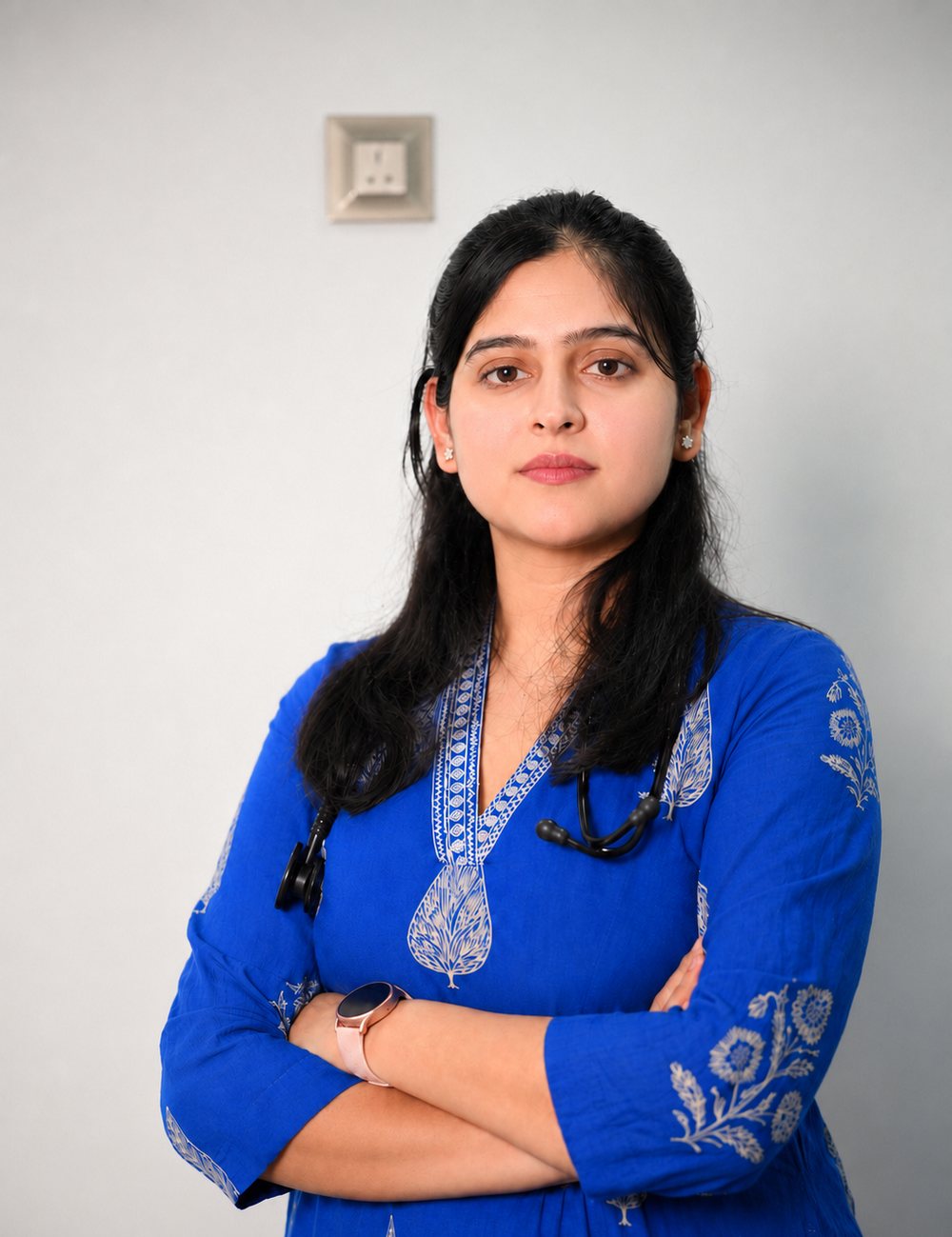
General Physician · Hyderabad
MBBS, MD (General Medicine)
A fever that won't settle. A niggling cough that refuses to go away. A blood sugar reading that has crept up. High blood pressure ignored for years. These are manageable — if they are taken seriously early and followed up honestly. I see patients at Yello Clinics in Kokapet and Bhoomi Hospitals in Manikonda.
My day is split between two clinics. Walk-ins are accepted at both, but you will wait less with an appointment.
About
General Physician · MBBS, MD (General Medicine)
I am a general physician practising in Hyderabad, with over eight years in internal medicine. I trained at Kakatiya Medical College, Warangal, interned at Gandhi Hospital, Secunderabad, and completed my MD in General Medicine at Mahatma Gandhi Medical College & Research Institute, Puducherry.
Since then I have worked as a Senior Resident in General Medicine at MGMCRI and, after a brief period in the Department of Medical Oncology at MNJ Institute of Oncology & Regional Cancer Centre (Osmania), as Junior Consultant in General Medicine at Vijay Marie Hospital, where I looked after inpatients and taught postgraduate students. I now consult at Bhoomi Hospitals, Manikonda and Yello Clinics, Kokapet. Alongside clinical practice, I teach on the Fellowship in Internal Medicine at Doctyn Academy.
My particular interests are infectious diseases, rheumatology and preventive medicine.
How I practise. I try to explain rather than instruct. A patient who understands why their HbA1c matters will be better able to manage the problem; one who has simply been told to will stop after a month. So I would rather spend a few extra minutes making sure it makes sense to you than hand over a prescription and move on. Bring the family member who will actually be managing the medications — they usually have the questions no one thought to ask.
A diagnosis lands on a whole household, not just on the person holding the report. Being told you have diabetes at forty, or that a parent's illness is a long one, is frightening, and the fear is often what stops people coming back. I make room for that in the consultation. Counselling and plain reassurance are part of the treatment, not something separate from it — and they are frequently the part that decides whether someone actually follows through.
Conditions
Fever is a symptom, not a diagnosis. The causes vary from ordinary viral illness through to dengue, typhoid, malaria, and urinary or chest infections. Most settle on their own. A few do not, and telling the difference early is the entire job.
Burning on passing urine, needing to go urgently and often, cloudy or foul-smelling urine, or pain in the lower abdomen. In older adults a UTI can present with nothing more than confusion or a fall, which is why it is missed so often.
A simple urine test confirms it. Where infections keep coming back, the right response is to look for a reason, not simply to repeat the same antibiotic. If there is fever, back or flank pain, or vomiting, the infection may have reached the kidney, and that needs to be seen the same day.
A cough with fever, breathlessness, chest pain on breathing in, or phlegm that has turned colour. This covers bronchitis through to pneumonia, and the distinction matters: many chest infections are viral and will settle without an antibiotic, while pneumonia needs one promptly.
Some patients require blood tests and a chest X-ray or a CT scan. Anyone who is elderly, diabetic, pregnant, or short of breath at rest needs assessing without delay.
Type 2 diabetes means your body can no longer keep blood sugar in a normal range. It develops slowly, often over years, and in the early stages it frequently causes no symptoms at all. That is precisely what makes it dangerous — by the time it announces itself, it has usually been present for some time.
A fasting blood sugar and an HbA1c, which reflects your average blood sugar over roughly three months. At the first consultation we also check blood pressure, kidney function and cholesterol, because diabetes rarely travels alone.
For some patients, changes to diet and activity are genuinely enough at the start. Some will need medication, and a few might need insulin — which is not a failure or a last resort, simply the right tool at the right time. The aim is steady control over years, which means regular reviews and follow-ups every three to six months.
Blood pressure that stays high puts continuous strain on your heart, kidneys, eyes and blood vessels. It very rarely causes symptoms. Almost everyone who has it feels completely well.
Usually none — and that is the whole point. Occasionally headaches, breathlessness or nosebleeds, but do not wait for those. If you are over thirty, have your blood pressure checked while you still feel fine.
One high reading in a clinic does not mean you have hypertension; anxiety alone can raise it. We confirm the diagnosis across several readings, sometimes with a home monitor or a 24-hour recording, and we check your kidneys and other cardiovascular risks at the same time.
Weight, salt, alcohol and activity all matter and can be enough in mild cases. Where medication is needed, the goal is a drug you tolerate well, because you may take it for many years. Side effects are worth reporting rather than enduring — there is nearly always an alternative.
The thyroid regulates your metabolism. When it is underactive, everything slows down; when it is overactive, everything speeds up. Both are common, and an underactive thyroid is particularly common in women.
A TSH blood test, with T3 and T4 where needed, and antibody testing if an autoimmune cause is suspected.
An underactive thyroid is treated with a daily tablet taken on an empty stomach. Finding the right dose takes a few rounds of testing over some months; once you are stable, a six-monthly check is usually enough. An overactive thyroid needs a detailed workup and has several treatment routes.
Joint pain is common and usually mechanical. Sometimes it is not. Inflammatory arthritis and autoimmune conditions behave differently from wear-and-tear pain, and they respond to early treatment far better than to late treatment.
Examination first, then targeted blood tests. Not every ache needs an RA factor test, and an abnormal result in someone with no symptoms causes more worry than it resolves.
Screening chosen for your age, sex, family history and risk — designed to catch things before they cause symptoms.
Blood pressure, blood sugar and HbA1c, lipid profile, complete blood count, thyroid function, kidney and liver function, and vitamin D or B12 where there is reason to check.
Comprehensive health-check packages often include tests you do not need. Every unnecessary test carries a chance of an abnormal result that leads to more tests and more anxiety, with no benefit at the end. I would rather work out which tests are actually useful for you than order all of them.
Vaccination is not only for children. Adults are under-vaccinated almost everywhere in India, and the people who would benefit most — those with diabetes, heart or lung disease, and anyone over sixty-five — are often the ones who have never been offered them.
If you are travelling, come in three to four weeks beforehand where you can. Several vaccines need more than one dose, and some need time to take effect.
Which vaccines you actually need depends on your age, your medical conditions, your work and where you are going. We go through your history and decide together — I would rather give you the two or three that genuinely protect you than a list you will not complete.
A fitness certificate is a doctor's assessment that you are medically well enough for a particular purpose. It is a clinical judgment, not a formality — which means it involves an actual examination, not simply a signature.
I provide certificates of general medical fitness — for employment, education, sports, travel and return-to-work. Statutory certificates that require a designated authority or board (such as driving, marine, aviation or disability certification) are issued elsewhere.
A relevant history and physical examination, and any tests the purpose calls for — often blood pressure, vision, and basic bloodwork. Bring a copy of the specific form or the requirement you have been given, along with your ID and any previous medical records.
I issue a certificate on the basis of what the examination shows. If you are well, that is straightforward. If something needs looking into first, I will say so rather than sign around it — a certificate is only worth anything if it is true.
Visit
Kokapet · Main practice
3rd Floor, GV PrideManikonda
Plot 44, 46 & 48